
Bed linen sizes
Europe has no single bedding size standard. In Britain and Ireland, sizes are commonly identified by names such as Single, Double, King and Super King, while across much of continental Europe dimensions are given in centimetres. Among the widely used duvet cover sizes are 140×200 cm, 160×200 cm and 200×220 cm. This guide brings these different conventions together. Beyond the listed European sizes, VON SCHÜTZ sews any technically feasible individual size in its ateliers in Poland and Germany.
We hold no finished bed linen in stock. Every set is made after you order.
Standard Bedding Sizes Across Europe
Two sizing systems sit side by side across Europe. In Britain and Ireland, duvet covers are commonly identified by named categories such as Single, Double, King and Super King, while across much of continental Europe the dimensions themselves serve as the size designation. Typical examples include 135×200 cm in German-speaking countries, 160×200 cm in Poland and parts of Central Europe, and 200×220 cm as a common double-duvet format in several European markets. Pillowcases follow the same regional logic: 50×75 cm in Britain, 80×80 cm and 40×80 cm in German-speaking countries, and 70×80 cm in Poland.
Different sizes are described as “standard” because no single binding norm applies across the market. What is considered standard is usually an established market convention, while individual retailers and brands may use additional sizes of their own — 150×200 cm and 240×220 cm are two examples. Every size mentioned here has its own entry in our size list; the decisive factor is always the actual measurement of your duvet.
Because we hold no finished bed linen in stock, 140×200 cm is not a shelf size for us, but a cutting dimension. A 140×200 cm duvet cover is made according to the same process as 280×240 cm or any individually specified size.
Why bedding sizes differ from country to country
A 180×200 cm bed may be described as a Super King in Britain and as a wide double elsewhere in Europe — the bed dimensions are the same, but the bedding conventions differ. In Britain, a bed of this size is commonly paired with one large duvet, while in Germany, Austria and Poland two separate duvets are also widely used. Neither approach is more correct; each leads to a different bedding arrangement. Our size list includes both systems, so a bed purchased in one country can be dressed according to the conventions of another. As always, the decisive measurement for the duvet cover is the duvet itself, not the bed.
Naming and writing conventions
Size conventions are not expressed in the same way across Europe. In France, dimensions are often written with the length first, so a size shown elsewhere as 240×220 cm may appear as 220×240 cm. A similar convention can occur in Slovakia for fitted sheets, where 160×80 cm denotes a sheet measuring 80×160 cm. In Spain, bedding sizes are often referenced through the width of the bed, as in Cama 90. Switzerland uses the term Duvetbezug for duvet covers and commonly works with a length of 210 cm. Where the same size appears under different names or writing conventions, the country table below shows both.
The Size Guide: Which Bed Linen Fits Which Bed?
The most reliable starting point is the mattress size, usually shown on its label. It directly determines the size of the fitted sheet. The duvet and pillow have their own dimensions: the duvet cover follows the size of the duvet, while the pillowcase follows the size of the pillow. Beds from other countries and older mattresses may measure 190 or 210 cm in length, which is why the fitted-sheet column includes these variants alongside 200 cm. The table takes you from the bed size to all three elements; every size listed is available.
70×140 cm (Children’s beds)
90×200 cm (Single Bed)
100×200 cm
120×200 cm
140×200 cm („French Bed”)
160×200 cm (Queensize)
180×200 cm (Kingsize)
200×200 cm (Family Bed)
Box-spring bed / topper
Other size
One Large Duvet or Two Separate Ones?
For double beds from 160 cm wide, there are two established approaches. Two separate duvets allow different warmth levels for each sleeper and avoid sharing one duvet during the night; this is a common arrangement in German-speaking countries and Poland. One large shared duvet provides continuous coverage across the centre of the bed and creates a calmer, more unified appearance. A 160×200 cm bed can accommodate either arrangement: two separate duvets or one larger shared duvet. Both options are shown in the table — the choice should follow how you sleep, not the bed linen.
For box-spring beds, larger formats or beds in international dimensions, a short enquiry is often simpler than working from the table alone: Oliwia, Atelier Concierge — personal advice by email and WhatsApp.
All Bed Linen Sizes at a Glance
82 sizes across four categories, as of August 2026 — 30 duvet cover sizes, 26 pillowcase sizes (plus a 15×40 cm bolster cover), 22 fitted sheet sizes and 4 flat sheet sizes. In the duvet cover and fitted sheet tables, the country column shows where each size is commonly used: DE/AT · CH · NL/BE · FR · UK/IE · IT · ES · PL · CZ/SK · DK · SE · GR · US and EU-wide. US formats are shown as explained equivalents. The designation column gives the name commonly used in each market; linked dimensions lead to the individual size page with available fabrics and prices.
Duvet covers — 30 sizes
For reference, percale duvet covers range from €58 to €196 depending on size, while complete bed linen sets start at €107. Each of these 30 sizes is made only after an order is placed — the table is not a stock list, but a reflection of the atelier’s size programme.
Pillowcases — 26 sizes, a bolster cover and one size on request
Pillowcase sizes vary across Europe. Our size programme includes established formats from Poland (70×80 cm), Austria (70×90 cm), Switzerland (65×65 and 65×100 cm), the Netherlands (60×70 cm), Denmark (60×63 cm), Sweden (50×90 cm) and German-speaking countries (80×80 and 40×80 cm). The table lists all sizes in configurator order; the 15×40 cm bolster cover is the 27th entry.
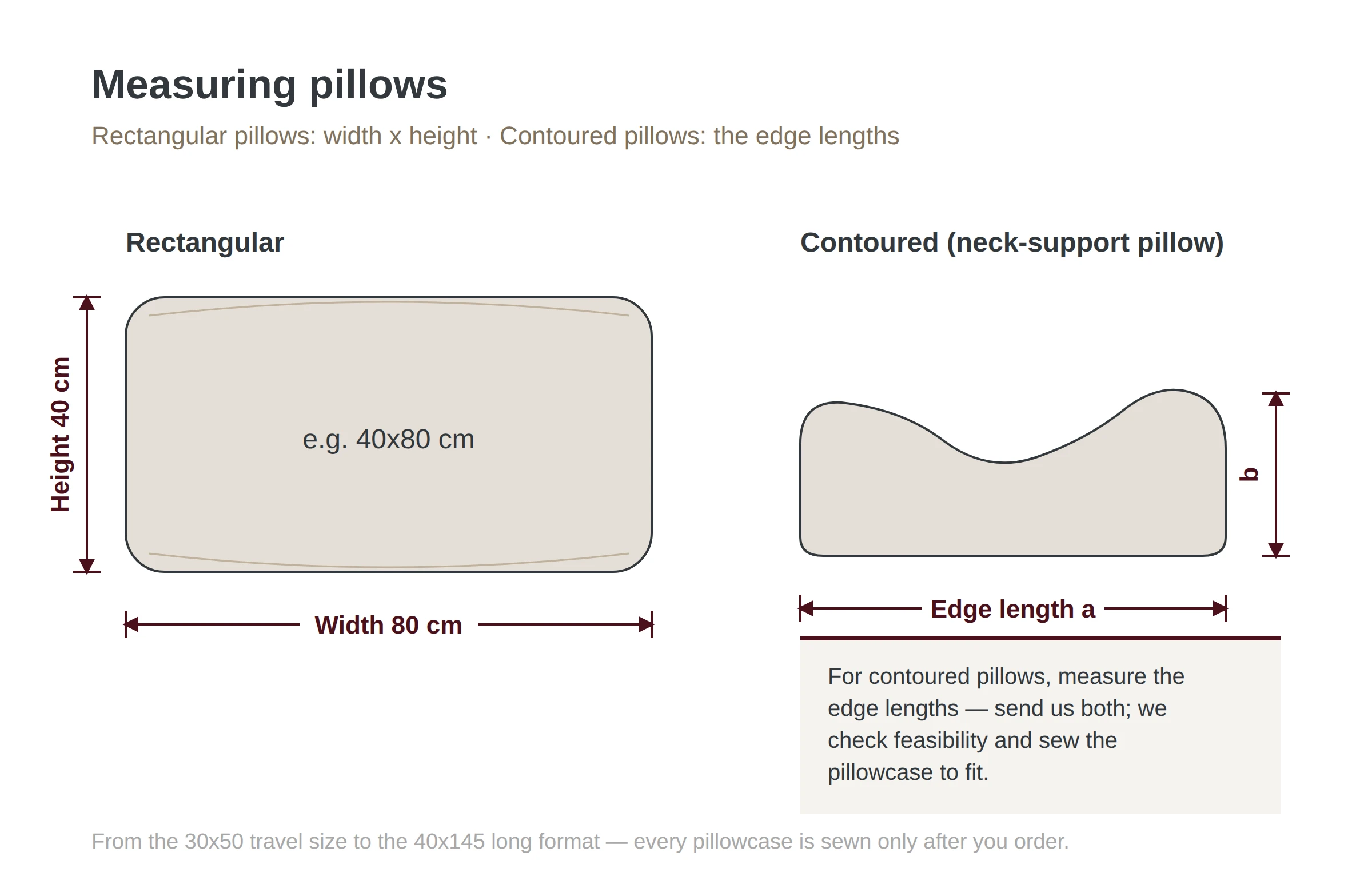
We also sew 45×145 cm on request, following the same process as every other size.
Fitted Sheets — 22 Sizes
The fitted sheets cover all four European bed lengths: 190, 200, 210 and 220 cm. Adult sizes fit mattresses and toppers with a combined height of 18 to 27 cm; children’s sizes have a 20 cm fitted depth for lower mattresses. Prices start at €45 for percale — see all fitted sheets.
In Sage Green, the configurator additionally offers 60×160 cm with a 20 cm fitted depth. For us, fitted depth is a construction detail rather than a standard fabric allowance: 30 cm for all adult sizes and 20 cm for the children’s sizes 60×120, 60×160, 70×140 and 80×160 cm. If you require a different fitted depth, specify it when ordering.
Flat Sheets — 4 Sizes
A flat sheet is a smooth sheet without elastic — either stretched over the mattress as a bottom sheet or placed between the sleeper and duvet as a top sheet: flat sheets without elastic. The 254×294 cm size corresponds to the Italian lenzuolo matrimoniale. How a top sheet contributes to a hotel-style bed is explained in the Hotel Guide.
The four sizes cover classic top sheets for single and double beds, including the Italian matrimoniale format.
Bed Linen Sizes Across Europe: Countries and Naming Conventions
European bed linen sizes follow different naming conventions. In Germany, Austria, Poland, France, Italy and the Netherlands, dimensions are generally given in centimetres. The United Kingdom and Ireland use terms such as Single, Double and King, while in Spain the width of the bed — for example, Cama 90 or Cama 135 — is often used as the starting point. For ordering, however, one detail remains decisive: the measured size of the duvet in centimetres.
Germany · Austria
Switzerland
Netherlands · Belgium
France
United Kingdom · Ireland
Italy
Spain
Poland
Tschechien · Slowakei
Denmark · Sweden · Norway · Finland
Hungary · Slovenia · Croatia · Greece
Every size mentioned here has its own entry in the size list above — linked dimensions lead directly to the corresponding size page.
Queen, King and International Bed Sizes
Queen and King refer to bed sizes, not bed linen sizes; their actual dimensions vary by country.
In the United Kingdom, King and Super King are established bed-size designations: a King bed measures 150×200 cm and is commonly paired with a 230×220 cm duvet, while a Super King measures 180×200 cm and commonly uses a 260×220 cm duvet. Other British bed sizes include Double at 135×190 cm, Small Double at 120×190 cm and Single at 90×190 cm.
In the United States, Twin, Queen and King refer to a different set of bed dimensions. In our size programme, 160×220 cm serves as an explained equivalent for a Twin duvet cover and 230×230 cm for Queen. In German-speaking countries, the terms Queen Size and King Size are also used for beds around 160×200 cm and 180×200 cm respectively. The same name can therefore refer to different dimensions from one country to another.
The designation alone is not decisive. What matters first is the actual size of the bed, followed by the measured size of the duvet. Custom Size Request.
French Bed (DE)
Queen Size (DE)
King Size (DE)
King (UK)
Super King (UK)
Duvet Sizes: Measure the Duvet First, Then Choose the Cover
The duvet cover follows the size of the duvet, not the size of the bed. When choosing a new cover, first lay the duvet flat without its cover and measure width × length in centimetres. The resulting dimensions are the correct duvet cover size.
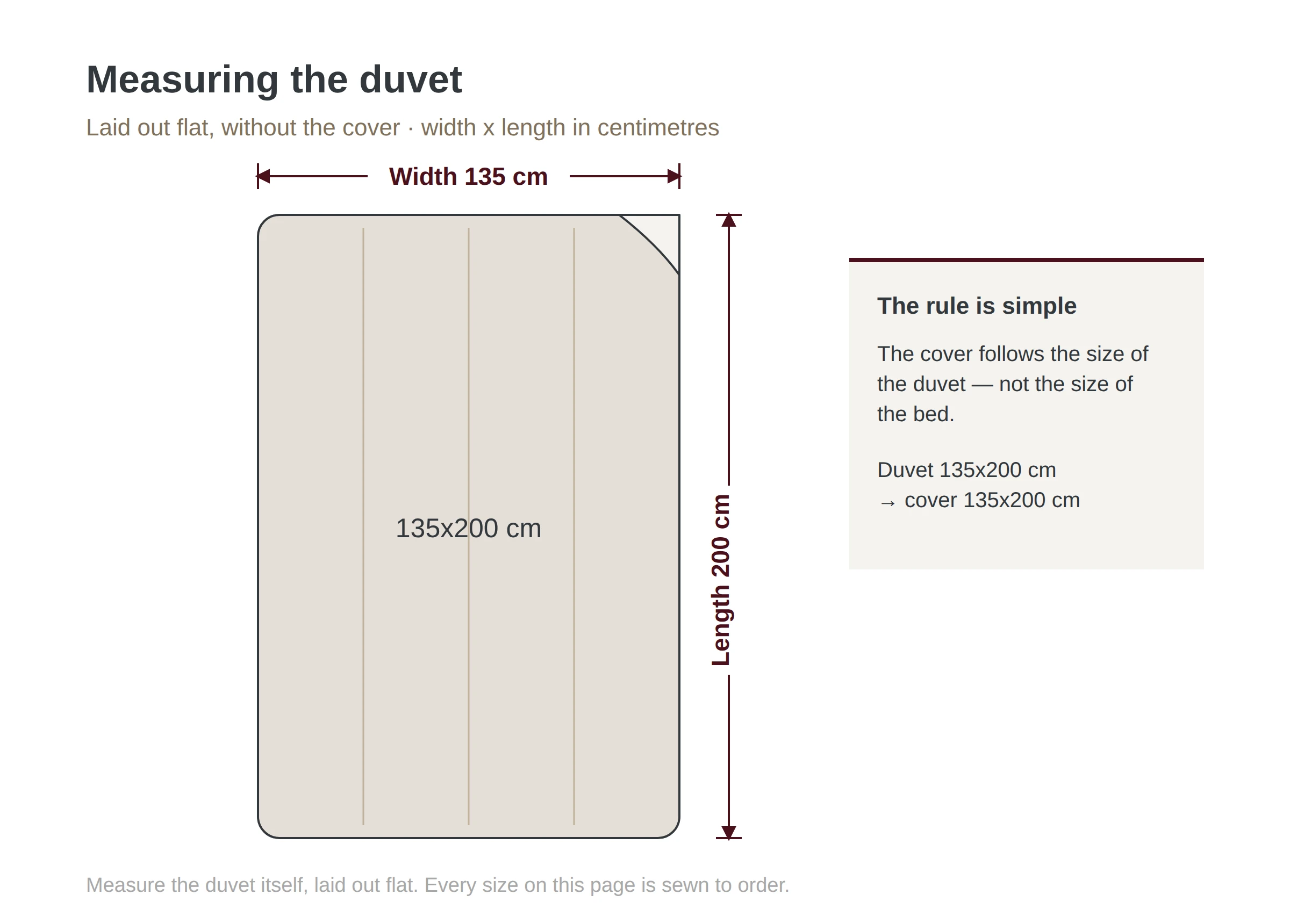
Duvet sizes follow the same regional conventions as duvet covers: 135×200 cm and 160×200 cm are widely used single-duvet sizes across continental Europe, while 200×220 cm and 240×220 cm are common larger formats for two people. In Britain and Ireland, duvet sizes are more often identified by names such as Single, Double and King. More important than the relationship to the bed frame is the height of the person or people sleeping beneath the duvet: it should cover the shoulders and feet even when changing position, while taller sleepers may prefer a length of 220 cm. A 180×200 cm bed can therefore be paired with one large duvet or two separate duvets; the different arrangements are explained in the Size Guide.
Once the duvet size is established, the corresponding cover size can be found directly in the size list — and if your duvet size is not listed, we will sew the cover to those exact dimensions.
Oversizes and Extra Lengths
Beyond the widely used standard sizes, larger formats form a regular part of our size programme. They appear as individual entries in the size list: 220×200, 220×220, 230×220, 230×230, 240×220, 240×240, 250×200, 260×220, 260×240 and 280×240 cm. The largest size in the list is 280×240 cm; for sateen, the configurator additionally offers 285×250 cm.
The second dimension is length. Extra lengths of 210 cm (150×210, 160×210, 200×210 cm) and 220 cm (140×220, 155×220, 160×220, 200×220 cm) are designed for longer beds and taller sleepers. For fitted sheets, this also applies to box-spring beds and mattresses with toppers: the 180×220 cm and 200×220 cm sizes fit mattresses 220 cm long, while the 30 cm fitted depth accommodates a mattress and topper with a combined height of 18 to 27 cm.
In our ateliers, a larger format follows the same process as any other size. We cut a 280×240 cm duvet cover only after the order is placed. The cut is larger, but the making process remains the same. Dimensions beyond those listed are made to your individual measurements.
The Hotel Bed: Sizes, Layers and Closures
A hotel-style bed is built around four layers and smooth, ordered surfaces rather than one particular fabric. The foundation is a fitted sheet, smoothly fitted over the mattress. A flat sheet is typically used as the top sheet, laid smooth and folded back at the head of the bed; the four sizes from 180×290 cm to 294×314 cm are listed in the Size List. The duvet in its cover is then arranged above it, folded or tucked at the foot of the bed.

The fourth layer is the arrangement of the pillows: a larger pillow at the back, a sleeping pillow in front, and a 40×40 cm or 50×50 cm accent cushion. Across Europe, the proportions vary — 80×80 cm and 40×80 cm are widely used in German-speaking countries, while 50×75 cm is common in Britain. For the deeper side drop associated with a hotel-style bed, a larger duvet can be chosen — for example, 240×220 cm instead of 200×220 cm for a 160×200 cm bed. As always, the duvet cover follows the size of the duvet. This is not a rule, but one possible way to arrange a hotel-style bed.
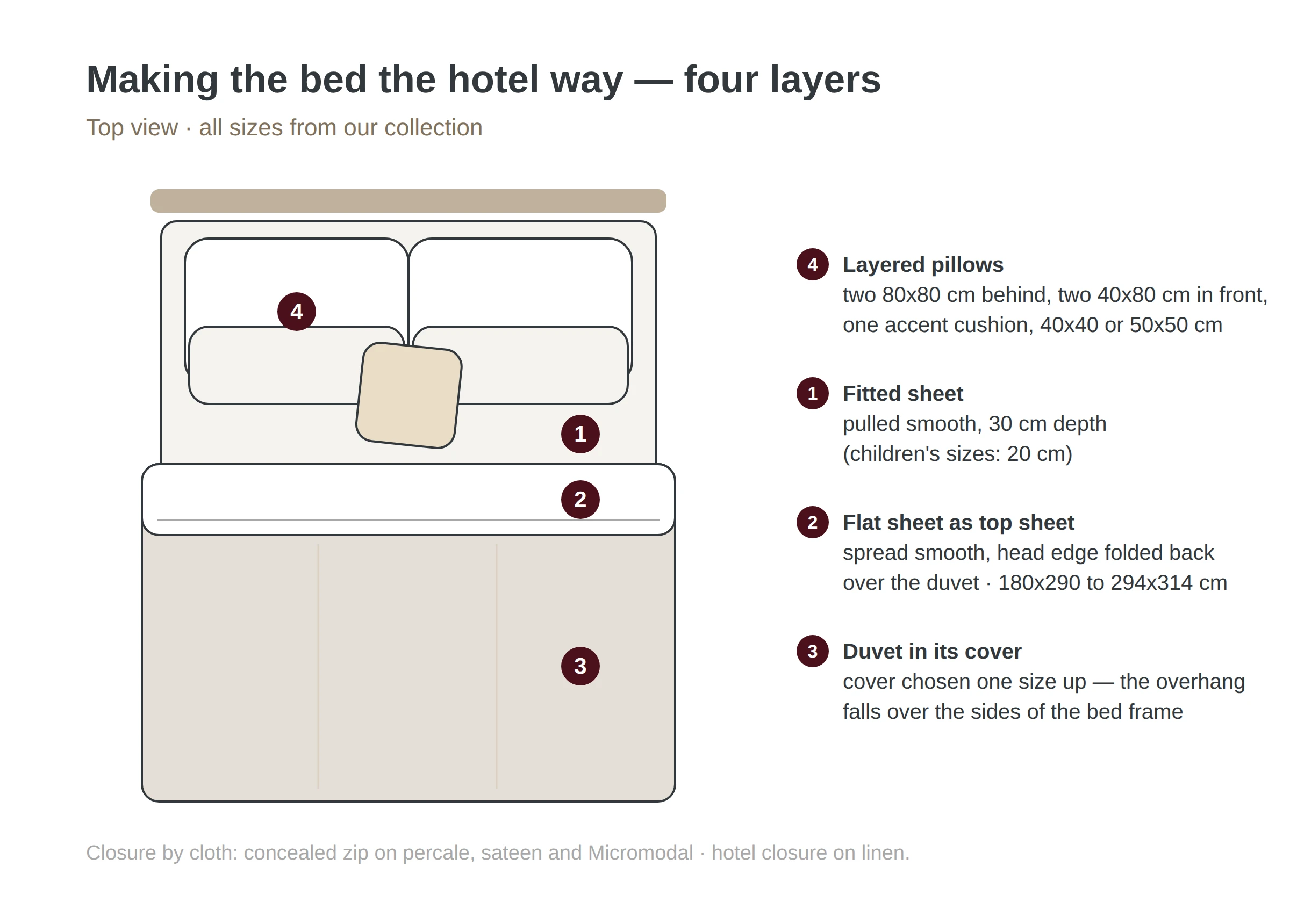
Hotels traditionally use a hotel closure: a sewn-in internal flap that holds the duvet in place without a zip or buttons — this is the construction we use for our linen. Percale, cotton sateen and MicroModal are finished with a concealed zip, giving the cover a clean, fully closed finish. Both solutions are deliberately matched to the character of the fabric: the classic hotel closure for linen, and a concealed zip for percale, cotton sateen and MicroModal. Percale is widely used in hospitality — a matt, dense plain weave weighing 120 g/m².
We also make bed linen for independent guesthouses and boutique hotels: Hotel & B2B.
Children’s Sizes
For duvet covers, we offer four children’s sizes: 90×120 cm (a common baby size in Poland), 100×135 cm (Germany, Austria and the Netherlands), 100×140 cm (a Danish junior size, known as enfant in France) and 120×150 cm (common in the Netherlands and known as Cot Bed in the United Kingdom).
Our fitted sheets in 60×120, 70×140 and 80×160 cm are made with a 20 cm fitted depth to suit lower children’s mattresses. A common pillow size is 40×60 cm, with smaller formats from 30×50 cm also included in the size list. From youth beds onwards, adult sizes apply.
Further baby and children’s sizes, such as 110×125 cm, can be made on request to your individual measurements.
If No Listed Size Fits: Your Custom Size
A bed from another country, an inherited down duvet in a less common size, or an extra-long box-spring bed — some dimensions fall outside standard size lists. In these cases, we make any size that is technically feasible. We make your size. Even 285×300 cm.
We also make sizes such as 135×220 cm, which are not included in many standard size lists. They are cut and sewn to your dimensions in our ateliers in Germany and Poland, following the same process as every size shown on this page. This is not a separate process — every size in the list above is made only after the order is placed.
Your custom size carries no surcharge — it is priced according to the same logic as every size in our size list. Every piece is made to order, with delivery within four weeks of order confirmation.
How to order: send us your dimensions as width × length in centimetres — for contoured pillows, provide the individual edge lengths — via the contact form, by email or WhatsApp. We will check feasibility and reply with the price.
The Fabrics Your Custom Size Is Made From
All fabrics featured on this page are woven in Northern Italy; the linen is sourced from Western Europe. When choosing between them, weave, weight and feel are the defining factors:
Percale — 120 g/m², a dense plain weave with a matt surface; cool and dry to the touch.
Cotton Sateen — 120 g/m², a sateen weave with a subtle lustre and soft drape.
MicroModal — 125 g/m², a sateen weave with a smooth surface and fluid drape.
Linen — 150 g/m², matt and tactile, becoming softer with every wash.
Each fabric is finished according to its character: a concealed zip for Percale, Cotton Sateen and MicroModal; a hotel closure for Linen. Care instructions and detailed material information can be found on the individual fabric pages.
All four fabrics are available in every size shown on this page — through the configurator or on request. How a fabric feels is ultimately decided by touch: request fabric samples — available for a sample fee that is fully credited towards your order.
Frequently asked questions about bed linen sizes
What is the standard bed linen size?
Europe has no single standard. In Britain and Ireland, sizes are commonly identified by names such as Single, Double, King and Super King, while across much of continental Europe dimensions are given in centimetres. Widely used duvet cover sizes include 135×200 cm, 160×200 cm and 200×220 cm. No single binding norm applies across these markets; the sizes are established market conventions. Every size shown on this page is made to order.
What bed linen sizes are available?
At VON SCHÜTZ, there are 82 sizes as of August 2026: 30 duvet cover sizes from 90×120 cm to 280×240 cm, 26 pillowcase sizes plus a 15×40 cm bolster cover, 22 fitted sheet sizes and 4 flat sheet sizes. Beyond these, we sew any technically feasible individual size in our ateliers — with no surcharge.
What bed linen size do I need?
Start with the mattress size: it directly determines the fitted sheet, while the duvet and pillow determine the sizes of their respective covers. For single beds, commonly used duvet sizes vary by country, while double beds can be paired with either two separate duvets or one larger shared duvet. The Size Guide above takes you from the bed size to the corresponding dimensions for each element.
How much does a custom-size duvet cover cost?
A custom size carries no surcharge: your individual dimensions are priced according to the same logic as every size in our size list. For reference, percale duvet covers range from €58 to €196 depending on size. To order, send us your dimensions as width × length in centimetres via the contact form, by email or WhatsApp.
What are standard duvet sizes?
Duvet sizes follow the same regional conventions as duvet covers. Across continental Europe, 135×200 cm and 160×200 cm are widely used single-duvet sizes, while 200×220 cm and 240×220 cm are common larger formats for two people. Children’s sizes include 100×135 cm. In Britain and Ireland, duvet sizes are more commonly identified by names such as Single, Double and King. To measure your duvet, lay it flat without its cover and measure width × length in centimetres.
Should the duvet be larger than the bed?
The duvet should suit the people sleeping beneath it rather than the bed frame: it should cover the shoulders and feet even when changing position during the night, while taller sleepers may prefer the extra length of 220 cm. The duvet cover then follows the size of the duvet. For the deeper side drop associated with a hotel-style bed, a larger duvet can be chosen — here too, the duvet cover follows the size of the duvet.
Why do different standard sizes appear across the market?
General market conventions differ from country to country, and individual retailers and brands may use additional sizes of their own. Britain and Ireland use named categories such as Single, Double and King, while across continental Europe dimensions such as 135×200 cm, 160×200 cm and 200×220 cm are widely used in different markets. Additional formats such as 150×200 cm or 240×220 cm may also appear in individual ranges. None of these dimensions is governed by a single binding standard. The decisive factor is always the actual measurement of your duvet — every size mentioned here is included in our size list.
What Size Is Queen Size?
Queen Size refers to a bed size, not a bed linen size, and its actual dimensions vary by country. In Germany, the term is often used for a 160×200 cm bed. Such a bed can be paired with one larger duvet or two separate duvets; the duvet cover then follows the size of the chosen duvet. In the US system, Queen denotes a different bed format; in our size programme, 230×230 cm is shown as the explained duvet cover equivalent.
What Is the Difference Between Queen Size and King Size?
The distinction depends on the country. In Germany, Queen Size is often used for a 160×200 cm bed and King Size for a 180×200 cm bed. In the United Kingdom, King and Super King are distinct bed-size designations: King measures 150×200 cm and is commonly paired with a 230×220 cm duvet, while Super King measures 180×200 cm and is commonly paired with a 260×220 cm duvet. The names are therefore not directly interchangeable across markets; the actual bed and duvet dimensions remain decisive.
Is a Queen Size Bed Suitable for Two People?
Yes. In continental Europe, a 160×200 cm bed is a common size for two people and is sometimes described as Queen Size. It can be paired with one large shared duvet or two separate duvets; the duvet cover always follows the size of the chosen duvet. Two separate duvets allow different warmth levels for each sleeper, while one shared duvet provides continuous coverage across the centre of the bed.
What Bed Linen Is Used in Hotels?
Percale is widely used in hospitality — a matt, dense plain weave that allows for a smooth, taut surface. A layered bed arrangement is also typical: a fitted sheet, a flat sheet used as a top sheet, a duvet in its cover, and layered pillows. The corresponding sizes — from a 180×290 cm flat sheet to an 80×80 cm pillow — are included in our size list.
Which Closure Suits Which Bed Linen?
For us, the closure follows the character of the fabric, and both systems are deliberate choices. Percale, cotton sateen and MicroModal are finished with a concealed zip, giving the duvet cover a clean, fully closed finish. Linen uses a hotel closure: a sewn-in internal flap holds the duvet in place without a zip or buttons, following the classic construction used in hospitality. If the closure matters to you, the choice of fabric also determines the finish.
What is a deep fitted sheet?
A deep fitted sheet has sufficient fitted depth for a thicker mattress or a mattress with a topper. Our adult fitted sheets have a 30 cm fitted depth and accommodate a mattress and topper with a combined height of 18 to 27 cm; children’s sizes have a 20 cm fitted depth. If you require a different depth, specify it when ordering.